AI Strategy
AI Execution
•
6 minutes
Why AI Implementations Fail: The Stanford Research
Stanford studied 51 enterprise AI deployments. 95% of failures were organizational, not technical. Here's what that means for your AI change management strategy.

Rafi Menachem
CEO & Founder
Share
Why AI Implementations Fail: What Stanford's Research Reveals About AI Change Management
The real problem isn't the technology.
Most firms we work with have deployed AI. ChatGPT Enterprise, Copilot, a model or two built in-house. The tools are live. Budgets were approved. Launches were announced.
Ask those same leaders six months later what's faster, what decisions actually changed, what the ROI looks like.
They go quiet.
AI adoption is everywhere. Impact isn't.
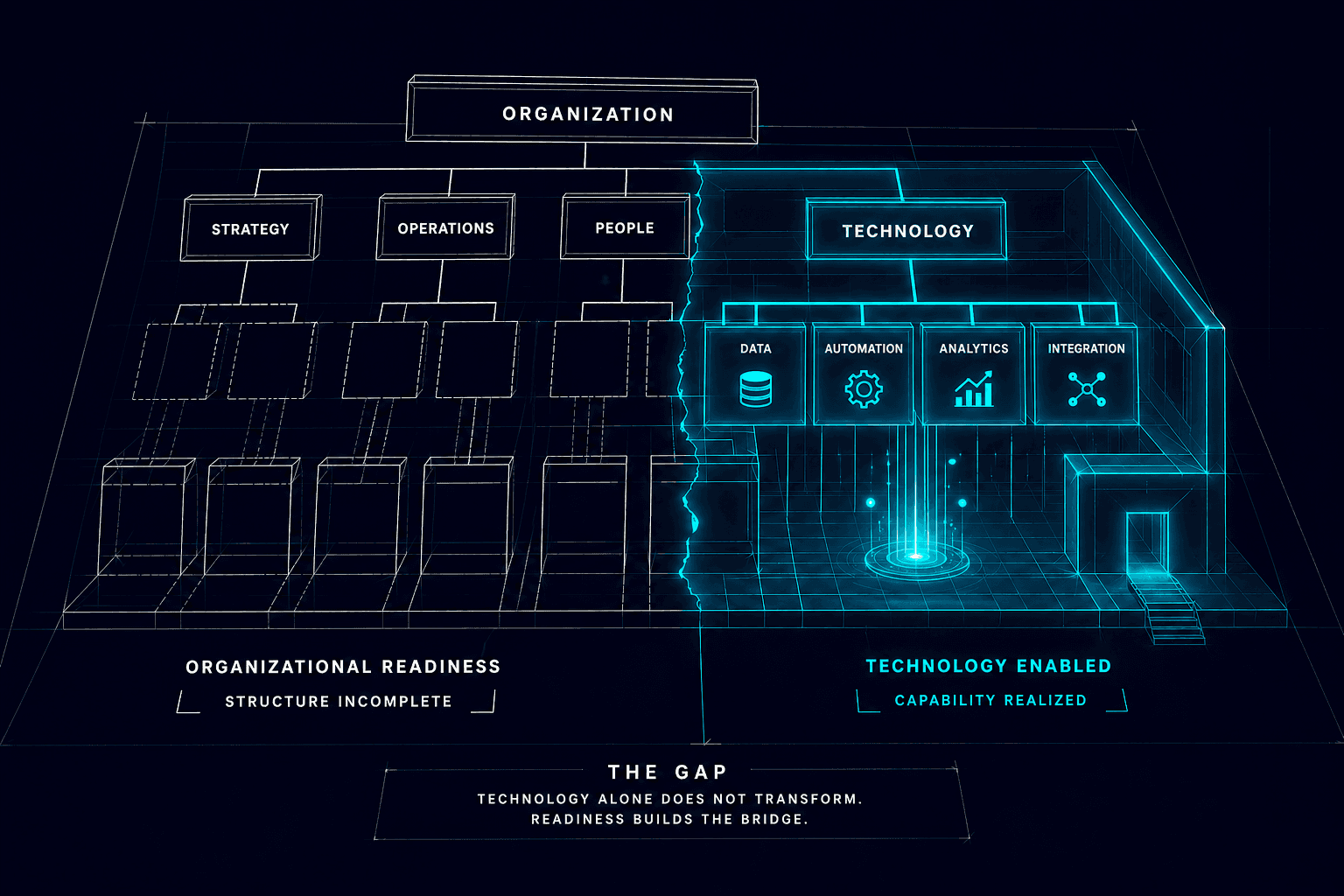
Stanford's Digital Economy Lab just put a number on why. Their March 2026 "Enterprise AI Playbook" analyzed 51 AI deployments across industries and organization sizes. The finding was precise: 95% of failures traced back to organizational unpreparedness. Not technical failure. Not bad models. Not messy data pipelines.
The technology performed. The organization wasn't ready for it.
This is an AI change management problem. And it's the one most firms are underinvesting in.
What Organizational Unpreparedness Actually Looks Like
Stanford identified three failure patterns that showed up consistently across underperforming deployments.
-
Governance built after launch, not before it. Accountability structures were retrofitted once problems surfaced, rather than designed to prevent them. Organizations that deployed governance retroactively spent months relitigating decisions that had already been made, compressing timelines, killing credibility, and stalling momentum that's hard to rebuild.
-
Workforce resistance treated as individual reluctance, not systemic ambiguity. The firms that succeeded addressed uncertainty structurally: clear communications about role impact, defined escalation paths, function-specific readiness plans. Firms that treated resistance as a training problem addressed the symptom. They never found the structure.
-
Executive ownership concentrated at launch and absent through adoption. In every successful deployment Stanford studied, named executive sponsors stayed accountable through every phase. Visible in governance decisions. Accountable for adoption milestones, not just launch announcements. The kickoff was the beginning of the executive's role, not the conclusion.
Here's the detail that should stop every consulting firm leader reading this: the most frequent blockers were legal, HR, and compliance teams. Not frontline employees. The people expected to use the tools were often willing. The institutional structures around them were not prepared.
Every week a deployment stalls in that gap is accumulated decision latency. Decision latency is the measurable cost of decisions being made more slowly, or not at all, because an AI capability exists in the organization but has not been operationalized at scale. It is a cost most organizations measure nowhere and feel everywhere.
What Is AI Change Management?
AI change management is the discipline of preparing people, structures, and governance for AI adoption before, during, and after deployment. It is not project management. It is not a training rollout. Its scope includes governance design, stakeholder alignment, workforce readiness, and the ongoing measurement of adoption outcomes, not just launch milestones.
Most organizations fund AI implementation thoroughly. AI change management gets a secondary line item or nothing at all. Stanford's analysis of 51 deployments tells us that inversion of priority is the primary driver of the 95% failure rate.
The organizations achieving durable performance are investing in both. The ones struggling funded the deployment and assumed adoption would follow. It doesn't work that way.
Why Governance That Enables Speed Is the Competitive Advantage
Here's the counterintuitive finding: governance-first organizations move faster.
When employees understand what AI can and cannot do in their role, when legal has cleared the use cases, when a path exists for handling AI-generated errors, the resistance patterns that derail most programs don't take hold. Because the uncertainty that creates resistance has already been resolved.
Governance that enables speed is not a contradiction. It is the sequencing Stanford's data consistently distinguishes successful from unsuccessful deployments. Well-governed AI programs compress the time between deployment and scale because they spend less time litigating edge cases mid-rollout.
For consulting firms: this is how you reframe governance to clients. Firms that position governance as risk mitigation make it feel like a cost. Firms that position it as an adoption accelerator earn executive investment instead of executive tolerance.
The difference in how you frame that conversation determines whether the program gets resourced properly.
How Do Organizations Move from AI Deployment to AI Adoption?
Organizations move from AI deployment to AI adoption by treating readiness as a structural design question, not an attitude management problem. Deployment creates access to AI capability. Adoption makes that capability part of how work gets done.
These are measured differently, and the distinction matters. Deployment is a milestone. Adoption is a rate. Most AI reporting tracks deployment milestones because they're easy to measure. Adoption rates, tracked by whether employees use tools consistently and whether that usage translates to productivity impact, tell you the actual ROI story.
What we see across our engagements: organizations that build adoption measurement into the deployment plan from the start can course-correct during rollout. Organizations that discover adoption gaps after the budget is spent have a much harder problem.
Adoption is the work. Tool selection, pilot design, executive approval are prerequisites. The firms that treat those milestones as the finish line produce deployment announcements without business outcomes. We see it regularly. Stanford just quantified why.
What the Broader Data Confirms
This isn't a Stanford-only finding.
Writer.com's 2026 enterprise AI report found that 79% of organizations face significant AI adoption challenges, a double-digit increase from the prior year, and that while 97% of executives report benefiting from AI, only 29% see significant organizational ROI. KPMG's Global Tech Report 2026 adds a parallel data point: AI is delivering business value for 74% of organizations, yet only 24% achieve solid returns across multiple use cases.
The pattern is consistent. Deployment is happening. Adoption at the depth required for organizational ROI is not keeping pace. The gap between those two states is exactly where AI change management operates.
For consulting firms advising clients on AI strategy, Stanford's research defines a professional obligation. A firm focused exclusively on technology selection and deployment is addressing the 5% of the problem the data identifies as less consequential. The organizational preparation that determines whether the technology actually performs at scale requires a different capability set and a different kind of engagement. AI-native consulting practices build change management into the delivery model as a core capability, because the research now confirms that is where the outcome is determined.
The Sequencing That Separates Scale from Stall
Syntari's Proof of Value → Scale → Sustain framework maps directly to what Stanford identifies as effective.
Proof of Value establishes what's possible inside the organization and builds internal credibility through early wins. Scale extends that proof across functions with governance in place before expansion, not after. Sustain embeds AI into operating rhythms so adoption holds and compounds, rather than decaying after the initial rollout.
That sequencing requirement is the most important practical takeaway from Stanford's research. Organizations that invest in governance and change management before scaling are not moving slower. They are avoiding the collapse that sends most AI programs back to the starting line.
The 95% failure rate is not a technology indictment. It is a sequencing diagnosis.
The Question Every AI Leader Needs to Answer
Stanford's research hands every AI leader a more useful question than "is our technology working?"
The real question: has our organization built the governance, workforce readiness, and executive accountability structures the data identifies as the difference between the 5% and the 95%?
Human intelligence, amplified, is what becomes possible when those structures are in place. The technology has been capable for some time. The organizing challenge in 2026 is whether the organizations deploying it are ready to let it perform.
If you're working through that question, Syntari Advisory is where we'd start — governance design through sustained adoption. For a broader frame on how AI transformation works in practice, there's more here: AI transformation for consulting firms.